

ISO 14644-1 Cleanroom Classification: Particle Count Limits & How to Verify Them
A cleanroom’s ISO class is not a design claim; it is a measured result, verified with a calibrated particle counter following ISO 14644-1. A failed classification can delay a facility opening or trigger an audit finding, so the limits and the procedure deserve attention.
This guide covers what ISO 14644-1 defines, the ISO Class 1–9 particle count limits, the sampling rules, and how a portable six-channel counter such as the CSJ-D2 verifies a cleanroom class on site.
What ISO 14644-1 Defines
ISO 14644-1:2015, the first part of the ISO 14644 series, defines nine cleanroom classes by the maximum permitted concentration of airborne particles equal to or larger than a stated size, expressed in particles per cubic metre (particles/m³).
- **The limits follow a formula.** For particle size D, the concentration limit is Cn = 10^N × (0.1/D)^2.08, where N is the class number; the table below gives the rounded values.
- **The scope is particles from 0.1 µm to 5 µm.** Air changes, pressure differentials, temperature, and humidity are handled elsewhere in the ISO 14644 series and in guidance such as EU GMP Annex 1.
The ISO 14644-1 Classification Table (ISO Class 1–9)
The table below gives the maximum permitted concentrations (particles/m³) per ISO class and particle size, from ISO 14644-1:2015 Table 1. A dash means no limit is specified for that combination.
| ISO Class | ≥0.1 µm | ≥0.2 µm | ≥0.3 µm | ≥0.5 µm | ≥1 µm | ≥5 µm |
|———–|———|———|———|———|——-|——-|
| ISO Class 1 | 10 | 2 | — | — | — | — |
| ISO Class 2 | 100 | 24 | 10 | 4 | — | — |
| ISO Class 3 | 1,000 | 237 | 102 | 35 | 8 | — |
| ISO Class 4 | 10,000 | 2,370 | 1,020 | 352 | 83 | — |
| ISO Class 5 | 100,000 | 23,700 | 10,200 | 3,520 | 832 | 29 |
| ISO Class 6 | 1,000,000 | 237,000 | 102,000 | 35,200 | 8,320 | 293 |
| ISO Class 7 | — | — | — | 352,000 | 83,200 | 2,930 |
| ISO Class 8 | — | — | — | 3,520,000 | 832,000 | 29,300 |
| ISO Class 9 | — | — | — | 35,200,000 | 8,320,000 | 293,000 |
Reading the Table: 0.3 µm, 0.5 µm, and 5 µm
Most classification work happens at three sizes:
- **≥0.5 µm** is the reference size for most pharmaceutical cleanrooms. An ISO Class 5 room must not exceed **3,520 particles/m³ at ≥0.5 µm** — the limit EU GMP Annex 1 sets for Grade A areas in operation.
- **≥0.3 µm** is measured where finer contamination control is needed; it is the smallest size many portable counters can resolve — including the CSJ-D2, with its 0.3 µm sensitivity. ISO Class 5 at ≥0.3 µm is 10,200 particles/m³.
- **≥5 µm** captures large particles relevant to sterile manufacturing: ISO Class 5 allows 29 particles/m³, ISO Class 7 allows 2,930, and ISO Class 8 allows 29,300.
Two pitfalls: the limits are per cubic metre (per-cubic-foot data from the withdrawn Federal Standard 209E cannot be compared directly), and the ≥ sign covers every particle at or above the stated size.
Sampling Rules in ISO 14644-1
The standard specifies how many locations to sample and how much air to draw at each one (Annex A of the 2015 edition).
Number of Sampling Locations
The minimum number of locations is the square root of the room area in square metres, rounded up, with a minimum of one and a maximum of 500:
- 10 m² → 4 locations
- 20 m² → 5 locations
- 100 m² → 10 locations
- 400 m² → 20 locations
Minimum Sample Volume and Time
At each location, the minimum sample volume is Vs = (20 / Cn,m) × 1,000 litres, where Cn,m is the class limit for the largest particle size considered. The sample must be at least 2 litres and 1 minute and may be split into portions meeting those minimums.
Practical examples at 2.83 L/min (0.1 CFM):
- **ISO Class 5, largest size 0.5 µm:** Vs = 5.68 L → about 2 minutes per location.
- **ISO Class 7, largest size 5 µm:** Vs = 6.8 L → about 2.4 minutes per location.
- **ISO Class 8, largest size 5 µm:** Vs = 0.68 L, so the 2 L minimum applies → 1 minute per location.
How a Portable 2.83 L/min Counter Is Used for Classification
A portable counter is the practical tool for classifying ISO Class 5 and above — the range covering pharmaceutical cleanrooms and hospitals:
- **Configure** the counter for the target class and state and select the channels (commonly 0.3, 0.5, and 5.0 µm).
- **Set the sample time** per location so the required volume is drawn, or let the auto-classification routine calculate it.
- **Sample the grid** of locations at working height, then **review the results** and confirm or reject the class on the spot.
- **Compare per-location averages.** The 2015 edition dropped the 95% upper confidence limit calculation of the 1999 edition; each location’s average is compared directly with the class limit.
- **One location over the limit fails the class.** If any location’s average exceeds the limit, the room does not meet that class.
- **State the state.** At-rest and operational results can differ by orders of magnitude; certificates should record the state, sizes measured, and the counter and calibration used.
- **Classification is a snapshot.** It proves compliance at the moment of testing; continuous assurance comes from monitoring under ISO 14644-2 or the Annex 1 contamination control strategy.
- Construction, renovation, or relocation of the cleanroom
- Major changes to HVAC, filtration, or pressurization
- A contamination incident, failed excursion, or failed monitoring
- A change of use (for example, ISO 8 re-rated as ISO 7)
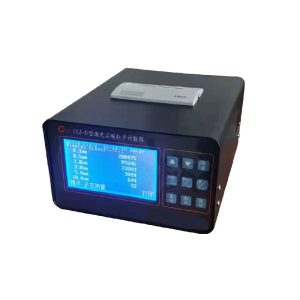
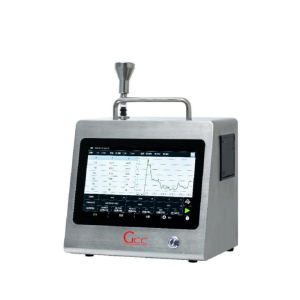
The GCC-CSJ-D2 Laser Airborne Particle Counter fits this workflow directly: six channels spanning 0.3–10 µm, 2.83 L/min sampling flow, 0.3 µm sensitivity, 246-group storage, and a built-in thermal printer. A 20 m² ISO Class 5 room (five locations, about two minutes each) can be sampled, evaluated, and documented in one visit, with printed records for the auditor. Its automatic evaluation covers ISO 14644-1 and Federal Standard 209E.
Interpreting the Results
When to Reclassify
ISO 14644-2:2015 sets a maximum interval of 12 months between classifications, with more frequent testing when a risk assessment calls for it. Reclassify sooner after any event that could change air cleanliness:
Conclusion
ISO 14644-1 classification is a measurement discipline: a class is only as credible as the counter, the sampling procedure, and the documentation behind it. A portable instrument with 0.3 µm sensitivity, six channels, and built-in ISO evaluation removes the practical friction — exactly what the CSJ-D2 laser particle counter was designed for. For help selecting a counter or planning a qualification, talk to GCC Cleanswan, a supplier of environmental monitoring instruments for pharmaceutical GMP laboratories, cleanrooms, hospitals, and research institutions, with more than 20 years of controlled-environment experience.
Need the right instrument for your application?
Talk to our engineers about specifications, documentation, calibration traceability and qualification support. We respond within one business day.
Frequently Asked Questions
What are the ISO 14644-1 particle limits for ISO Class 5?
ISO Class 5 allows 3,520 particles/m3 at >=0.5 um and 29 particles/m3 at >=5 um.
How many sampling locations do I need?
Per ISO 14644-1, the minimum number of locations is the square root of the room area in m2. For example, a 100 m2 room needs at least 10 locations.
How long does classification sampling take?
Each location requires a minimum sample volume (2 L or 20/Cn,m x 1000 L, whichever is larger). At 2.83 L/min a 1,000 L sample takes about 6 hours; at 100 L/min it takes about 10 minutes.
How often must a cleanroom be reclassified?
ISO 14644-2 recommends particle count verification every 6-12 months, with the interval justified by risk. Reclassification is also required after major changes to the facility or HVAC system.