

100 L/min vs 2.83 L/min Particle Counters: Which Sampling Flow Rate Do You Need?
Every laser airborne particle counter draws air at a fixed rate, and that one number shapes how your whole monitoring program runs. Two flow rates dominate the market: 2.83 L/min (0.1 cfm), the classic handheld rate, and 100 L/min (3.53 cfm), the workhorse rate for cleanroom classification. The difference is roughly 35x more air per minute, and that changes sampling time, compliance effort, and cost.
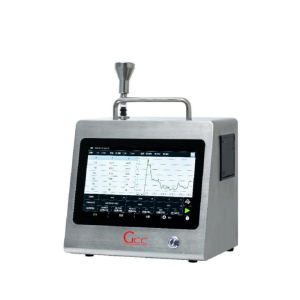
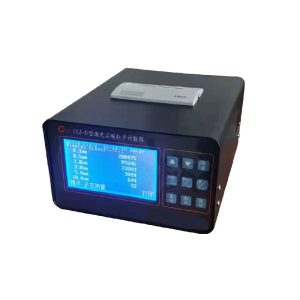
This guide compares the two rates using two GCC Cleanswan instruments as reference points: the CSJ-D2 2.83 L/min particle counter (six channels, 0.3 um sensitivity) and the MST-5100XPro 100 L/min particle counter (six channels, 0.5–25 um).
Why sampling flow rate matters
A particle counter reports a concentration, but it really just counts particles in a known volume of air. Sample faster, and you reach the volume your protocol demands sooner. Three consequences follow:
- **Sampling time.** ISO 14644-1 sets a minimum sample volume per location. A faster flow reaches that volume in minutes instead of hours.
- **Counting statistics.** More air in the same window means more counted particles, so low concentration limits can be resolved with confidence.
- **Workflow capacity.** If each location takes six hours, you cannot classify a room in one shift. At ten minutes, you can run dozens of locations and release the room the same day.
The math: ISO 14644-1 minimum sample volume
ISO 14644-1:2015 requires a minimum sample volume per location of:
Vs = (20 / Cn,m) x 1000 L, with an absolute minimum of 2 L
Cn,m is the class limit for the largest considered particle size. For an ISO Class 5 room at the ≥5 um size (limit 29 particles/m³), the minimum volume is about 690 L per location. Round up to a 1,000 L sample and the flow rate decides the day:
- At 2.83 L/min, a 1,000 L sample takes about 353 minutes, roughly **six hours per location**.
- At 100 L/min, the same sample takes **ten minutes**.
Regulators push volumes up too. EU GMP Annex 1 requires a minimum sample volume of 1 m³ per location for Grade A and B areas at the ≥5 um size. At 2.83 L/min that is a full working day per location; at 100 L/min it is ten minutes.
Location count scales with area too: ISO 14644-1 sets the minimum number of sample locations at the square root of the room area in square metres, rounded up (10 for a 100 m² room, 23 for 500 m²). At 690 L per location, 23 locations means about 94 hours of sampling at 2.83 L/min versus about 2.6 hours at 100 L/min.
When a 2.83 L/min counter is enough
The 2.83 L/min rate remains a standard for good reasons. It suits:
- **Small rooms and limited locations**, where total sampling time stays reasonable.
- **Routine monitoring** of stable, well-characterised cleanrooms, where you track trends rather than classify from scratch.
- **Spot checks, troubleshooting, and filter leak scanning**, where the counter travels with the technician.
- **Small minimum volumes.** For an ISO Class 5 room at ≥0.5 um, the minimum sample volume is about 5.7 L, roughly two minutes at 2.83 L/min.
The CSJ-D2 fits this profile. It detects particles down to 0.3 um across six channels (0.3–10 um), stores 246 groups of data, prints results on a built-in thermal printer, and evaluates cleanliness class automatically. Compliant with ISO 14644 and Fed-Std-209E, it documents routine checks without a laptop or a cart, at a lower capital cost than a high-flow unit.
When you need a 100 L/min counter
Switch to 100 L/min when time or volume makes 2.83 L/min impractical:
- **Large rooms and halls**, where dozens of locations multiply per-location time.
- **High ISO classes.** Lower concentration limits push required volumes up, and only a high-flow instrument keeps the job schedulable.
- **GMP production lines.** Grade A and B monitoring under Annex 1 demands 1 m³ per location at ≥5 um; that volume is practical only at high flow.
- **Time-constrained release.** When production waits on the result, ten minutes beats six hours per location.
- **Isokinetic sampling in moving air.** In ducts and high-velocity air streams, the probe inlet velocity should match the air velocity so particles are neither under- nor over-sampled. A 100 L/min inlet reaches the velocities where isokinetic conditions become meaningful; a 2.83 L/min inlet is effectively a point sampler for low-velocity room air.
The MST-5100XPro is built for this role: 100 L/min sampling, six channels covering 0.5–25 um, aimed at cleanroom classification and GMP-compliant environmental monitoring.
Tradeoffs beyond flow rate
Flow rate is not the only difference.
- **Minimum detectable size.** The CSJ-D2 resolves particles down to 0.3 um; the MST-5100XPro starts at 0.5 um. ISO 14644-1 allows classification at several size thresholds; if your protocol requires the 0.3 um limit, only a 0.3 um-capable counter will do. If your reporting is built around ≥0.5 um and ≥5 um, the 100 L/min unit covers that and adds reach to 25 um.
- **Size and weight.** 2.83 L/min handhelds are compact, battery-powered, and easy to carry between rooms. 100 L/min instruments are larger and heavier, often cart-mounted, with higher power draw.
- **Price.** The 2.83 L/min class is generally the lower-cost option; the 100 L/min class carries a higher price for its speed and throughput.
Comparison table
| Specification | CSJ-D2 | MST-5100XPro |
|—|—|—|
| Sampling flow rate | 2.83 L/min (0.1 cfm) | 100 L/min (3.53 cfm) |
| Channel count | 6 | 6 |
| Particle size range | 0.3–10 um | 0.5–25 um |
| Minimum detectable size | 0.3 um | 0.5 um |
| Data storage | 246 groups | — |
| Built-in thermal printer | Yes | — |
| Standards | ISO 14644, Fed-Std-209E | ISO 14644 classification, GMP monitoring |
Recommendation
Match the instrument to the job.
Choose the CSJ-D2 when you monitor small or medium rooms, need 0.3 um sensitivity, value portability, and want a lower-cost unit with built-in printing.
Choose the MST-5100XPro when you classify large rooms, work under GMP or Annex 1 sample volumes, monitor production lines, or need results within a shift.
Many GMP facilities keep both: a high-flow unit for classification and routine environmental monitoring, plus a handheld for spot checks, excursions, and filter integrity work. If you are buying your first counter, start from the largest sample volume your protocols require, then calculate how long each flow rate takes per location. The calculation rarely points to the wrong answer.
Conclusion
The choice between 100 L/min and 2.83 L/min is really a choice about time, volume, and particle-size reach. The CSJ-D2 covers routine monitoring with 0.3 um sensitivity, onboard storage and printing, and a portable footprint. The MST-5100XPro turns ISO 14644 minimum volumes and Annex 1 requirements into a ten-minute job per location. Neither is universally better; the right flow rate is the one that fits your room size, your class limits, and your release schedule.
If you are weighing the two, compare the CSJ-D2 2.83 L/min particle counter and the MST-5100XPro 100 L/min particle counter side by side, or browse the full instrument range at GCC Cleanswan. GCC Group has worked in controlled environments for more than 20 years, so the advice comes with application experience behind it.
Need the right instrument for your application?
Talk to our engineers about specifications, documentation, calibration traceability and qualification support. We respond within one business day.
Frequently Asked Questions
What is the difference between 2.83 L/min and 100 L/min particle counters?
A 2.83 L/min counter samples 0.1 cfm per minute, while a 100 L/min counter samples 3.53 cfm. At 100 L/min you collect the same sample volume roughly 35 times faster, which matters when ISO 14644 requires large sample volumes.
Why would I choose a 2.83 L/min counter?
Smaller, lighter, lower cost and suitable for routine monitoring in small areas. It is the classic portable instrument for spot checks and smaller cleanrooms.
When is a 100 L/min counter necessary?
For large rooms, high cleanliness classes, production line monitoring, and applications where long sampling time is not acceptable. It also enables isokinetic sampling at higher flow velocities.
Does the MST-5100XPro detect 0.3 um particles?
No. The MST-5100XPro six channels cover 0.5-25 um, which is the range typically used for ISO classification and GMP monitoring at 0.5 um and 5 um. For 0.3 um sensitivity, use a 2.83 L/min counter such as the CSJ-D2.