

When a new cleanroom is handed over, construction may be finished — but the facility is not yet qualified. Qualification is not a single test or a one-time inspection. It is a structured, documented process that proves a cleanroom performs to its design specification and remains in control throughout its working life. That process is cleanroom qualification: the four-stage sequence of DQ, IQ, OQ and PQ that regulators, auditors and end users expect from any ISO or GMP classified facility.
For manufacturers in pharmaceuticals, biotechnology, semiconductors and advanced manufacturing, an unqualified cleanroom is a liability: batches may be rejected, audits may fail and production may be halted. This article explains what each stage involves and what data it produces.
Key Takeaways
- Qualification proves a cleanroom meets its design and regulatory requirements through documented evidence.
- DQ verifies design, IQ verifies installation, OQ verifies operation, PQ verifies performance.
- OQ includes particle classification, HEPA integrity, airflow, smoke, pressure and recovery tests.
- ISO 14644-2 recommends particle count verification every 6-12 months.
Why Cleanroom Qualification Matters
Qualification is the evidence trail that connects a cleanroom’s design intent to its verified performance. It matters for three reasons.
First, regulatory compliance. GMP-regulated industries are inspected against the expectations of EU GMP Annex 1, which places contamination control at the centre of aseptic manufacturing. Recent Annex 1 revisions have tightened requirements for cleanroom classification, monitoring and risk assessment. Inspectors now expect documented qualification of facilities and systems, not just routine testing.
Second, harmonised standards. ISO 14644 cleanroom certification provides the technical backbone: ISO 14644-1 defines classification by airborne particle concentration, ISO 14644-2 sets monitoring and requalification schedules, and ISO 14644-3 covers test methods. Compliance with these standards makes qualification results internationally accepted and defensible.
Third, operational assurance. Qualification verifies that HVAC validation, airflow, filtration and pressure control perform as designed before products are exposed to risk.
Design Qualification (DQ)
DQ confirms that the cleanroom design meets the user requirement specification (URS), the applicable standard and the process it will support. It is the foundation of the entire programme: every later stage is tested against decisions locked in here, so DQ errors are the most expensive errors to find late.
Layout, HVAC Calculations and FFU Layout
DQ reviews room layout against process flow, material and personnel routes, and zoning. HVAC validation begins at this stage with heat-load calculations, air-change rate determination and selection of air handling units or fan filter units. For ISO Class 5 and cleaner zones, the FFU layout is assessed for coverage, redundancy and the ability to maintain unidirectional airflow across critical work areas.
Airflow Simulation and Pressure Cascade Design
Pressure cascade design defines the differentials that keep contamination moving from cleaner to less clean areas. DQ typically includes airflow simulation to model air distribution, verify sweep patterns and identify dead zones before construction — far cheaper to correct in a model than in a built room.
Material Selection
Surfaces must be cleanable, durable and compatible with disinfection agents. DQ documents the rationale for wall panels, flooring, ceiling systems, doors and finishes against cleanability, chemical resistance and particle-shedding criteria.
Installation Qualification (IQ)
IQ verifies that the cleanroom was built and installed exactly as designed. It is a systematic, item-by-item check of the physical facility against the approved drawings and specifications.
The IQ protocol confirms that wall panels, ceilings, flooring and doors are installed to specification with correct seals, joints and finishes. It verifies FFU counts and locations against the layout drawings, records HEPA filter models and serial numbers, and checks fan performance data, motor ratings and speed settings. Electrical systems, grounding and ESD protection are verified, along with lighting levels, emergency systems and door interlock operation. Every check is recorded against the design documentation; deviations are logged, assessed and resolved before the next stage begins.
Operational Qualification (OQ)
OQ proves that the cleanroom operates within its specified parameters. This is where the facility’s environmental performance is measured under defined conditions, typically at-rest, and where most certification testing takes place.
Airborne Particle Classification
Airborne particle counts are performed to ISO 14644-1 using the specified sampling locations and sample volumes to confirm the room meets its target classification.
Airflow Velocity and Uniformity
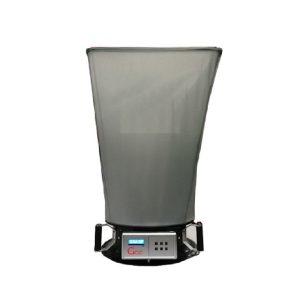
Airflow velocity is measured across the work plane, particularly in unidirectional airflow zones, to confirm uniformity and compliance with design velocity ranges. On site, this is where instruments such as the GCC-FL-A1 airflow meter deliver accurate, repeatable velocity data for the test report.
HEPA Integrity Test (PAO/DOP)
Each HEPA filter and its installation frame are scanned for leaks using a PAO or DOP aerosol challenge and photometric detection — the HEPA integrity test, performed to ISO 14644-3. The GCC-WIT-2ii aerosol photometer is a typical instrument for this work, enabling upstream concentration verification and downstream scan testing of every filter and seal.
Smoke Visualization for Laminar Flow
Smoke or fog visualization confirms airflow patterns in critical zones, demonstrating that laminar flow sweeps the work area and that air does not stagnate or recirculate across exposed product.
Pressure Differentials and Temperature/Humidity Stability
Pressure differential tests verify cascade direction and magnitude between adjacent rooms, including alarm and interlock response. Temperature and humidity are mapped over time to demonstrate stability within specification, including recovery after door openings.
Recovery Test
The recovery test measures how quickly the room returns to its classified state after a controlled particle challenge, confirming the effectiveness of air-change rate and filtration.
Performance Qualification (PQ)
PQ demonstrates that the cleanroom performs reliably in service. Testing is repeated under at-rest and operational states — equipment running, personnel present and, where applicable, simulated production. PQ confirms that real-world activity does not push the room out of specification and establishes the baseline for routine environmental monitoring. For GMP cleanroom validation, PQ results also feed the monitoring plan: sampling locations, frequencies and alert and action limits.
Qualification Documentation and Reports
Qualification is only as strong as its documentation. Each stage produces a protocol, executed test data, deviation records and a summary report with clear pass/fail conclusions. The complete V-model documentation set — URS, DQ, IQ, OQ and PQ — forms the compliance file auditors request first. It should be delivered as a complete, traceable package: protocols prepared to your standards, executed by trained engineers, and reported with raw data and certificates of conformity.
How Often Should You Requalify?
Qualification is not a one-time event. ISO 14644-2 sets the requalification schedule: airborne particle counts are typically repeated every 6–12 months, while HEPA integrity testing and airflow measurement are commonly scheduled at 6–24 month intervals depending on classification and risk. Pressure differentials are usually verified far more frequently — often continuously through monitoring systems — with formal re-verification aligned to the requalification cycle. Any major modification, deviation or contamination event triggers immediate re-testing of the affected systems regardless of the calendar schedule.
Choosing a Qualification Partner
A qualification partner should bring three things: technical depth across cleanroom engineering and testing, instruments that are calibrated and traceable, and documentation discipline. The team that understands HVAC validation, pressure cascade design and contamination control should be the same team verifying the finished facility — that continuity closes the gaps that appear when design and testing are handled by separate parties.
Conclusion
Cleanroom qualification DQ, IQ, OQ and PQ is the bridge between a cleanroom as drawn and a cleanroom as proven. Done properly, it satisfies ISO 14644 cleanroom certification requirements, meets GMP expectations and gives production teams confidence in every batch.
GCC CleanSwan provides qualification and validation services across the full lifecycle — from design qualification through performance qualification and requalification — backed by ISO and GMP clean environment technology expertise and more than two decades of GCC Group engineering experience. Contact our team to discuss your cleanroom qualification programme.
Need the right instrument for your application?
Talk to our engineers about specifications, documentation, calibration traceability and qualification support. We respond within one business day.

Frequently Asked Questions
What is the difference between DQ, IQ, OQ and PQ?
DQ verifies the design meets requirements, IQ verifies correct installation, OQ verifies operational performance against specifications, and PQ verifies performance under simulated production conditions.
Which tests are performed during OQ?
Airborne particle classification, airflow velocity and uniformity, HEPA integrity (PAO/DOP), smoke visualization, pressure differentials, temperature and humidity stability, and recovery tests.
How often must a cleanroom be requalified?
ISO 14644-2 recommends particle count verification every 6-12 months. Full requalification is typically performed annually or after significant changes to the facility.
Do I need qualification documents for a GMP audit?
Yes. Auditors expect documented DQ/IQ/OQ/PQ protocols, test results, calibration certificates and deviation handling as evidence of environmental control.